
Criminal Cases in Wright County Courts
Wright County belongs to Missouri's 44th Judicial Circuit, which also includes Douglas and Ozark Counties. Circuit divisions hear felony prosecutions. The associate circuit division handles misdemeanors and preliminary felony work assigned by state law. Missouri's authorized felony dispositions, imprisonment ranges by offense class, and criminal fine provisions supply legal context, but the charge-level judgment controls the actual result. City municipal courts hear ordinance cases, so a city ticket may not begin as a state criminal case. Court and venue matter because two files involving the same name can reflect different conduct, charges, and outcomes.
The Wright County Circuit Clerk is custodian of the local circuit and associate case files. The Missouri court directory is the official route for confirming current court contact details. The clerk's counter at 125 Court Square in Hartville is the source for copies, certifications, and records not available from home. The court case file is distinct from the sheriff's incident or booking record. It shows what the prosecutor actually filed and what the judge decided. For a city ordinance matter, confirm the municipal venue and its Case.net entry before asking the circuit clerk for a document.
Wright County Criminal Court Divisions
The label “44th Judicial Circuit” does not by itself identify Wright County. A Case.net user must choose Wright as the county or court location. That one filter avoids mixing local cases with dockets from Douglas or Ozark County. The court type also gives context: a felony matter normally sits in circuit court, while a misdemeanor may appear in the associate division.
Municipal ordinance files form a third track. Their charge labels may look like criminal allegations, yet the city court is enforcing a local ordinance. Read the court location, case type, and charging text together. If a ticket was transferred or filed as a state case, the newer Wright County docket is the key record. The 44th Judicial Circuit local rules identify the circuit and its procedures, while the docket identifies the specific venue.
How to Search Case Records
Missouri Case.net is the free first stop for public Wright County criminal court records, and the judiciary's Case.net access explanation describes the public service and its limits. Exact case numbers give the cleanest match. A name search can work well, but common names need a first name, middle name, criminal case type, or filing date. Confidential cases and protected documents do not appear in the public view.
- Open Case.net and select Litigant Name, Case Number, Filing Date, or Scheduled Hearings and Trials.
- Choose Wright County, not just the 44th Judicial Circuit.
- Enter the exact case number when known. Otherwise, combine the legal name with the criminal case type.
- Open the case number and read the header, parties, docket, charges, judgments, sentences, service, and financial tabs.
- Give that case number to the Wright County Circuit Clerk when requesting a certified or remotely unavailable document.
| Search control | Type | Use | Wright County note |
|---|---|---|---|
| Litigant Name | Search route | Party name | Use legal spelling and narrow common names |
| First and middle name | Text | Optional | Helps separate similar results |
| Case type | Dropdown | Optional | Select criminal when offered |
| Court or county | Dropdown | Recommended | Select Wright County |
| Case number | Search route | Best exact route | Use the full identifier |
| Filing date | Date route | Optional | Narrows a known filing period |
| Scheduled hearings | Calendar route | Optional | Search by date and location |
Case.net Wright County Filters
A search result is only the start. Open the case number rather than judging a matter from the results line. The Case Header identifies status and venue. Parties and Attorneys shows the named participants. Docket Entries gives the event sequence, while Charges, Judgments, and Sentences supplies the count-level result. Financial Information may show court costs or balances, and Service Information can document notices or process.
“Track This Case” can send email notices for eligible dockets. Cases handled by the Fine Collection Center may not qualify. A linked docket entry can signal an attached document, but public remote access depends on document security and user role. Court-provided terminals may expose a broader public viewer than anonymous home access. If a known case is missing, try a name variant, remove the middle name, confirm Wright County, then ask the clerk about archived or confidential-status material.
What the Case File Shows
A Wright County case file follows the prosecution, not the arrest alone. Filed charges may differ from the counts listed at booking. Read each charge row through disposition and sentence. A case-level label can hide the fact that one count was dismissed while another ended in a plea or judgment. The docket date and text then show when hearings, motions, pleas, and orders occurred.
| Case number and court | Unique docket identifier, case style, filing date, location, type, and assigned judge |
|---|---|
| Charging record | Filed offense, statute, class, alleged date, complaint, information, or indictment |
| Docket entries | Dated text for filings, settings, appearances, motions, and orders |
| Hearings | Date, time, hearing type, continuance, and appearance information when public |
| Disposition | Plea, dismissal, acquittal, judgment, and result for each filed count |
| Sentence | Confinement, probation, fine, restitution, costs, or suspended imposition of sentence |
Confidential identifiers and protected documents are omitted. A public docket can establish the case path without revealing every exhibit, report, or private fact. For the arrest and booking side of the event, use the separate Wright County arrest history channels.
Reading Wright County Case Outcomes
Disposition means the result of a charge. A conviction follows a guilty plea or finding. A dismissal ends that count without a conviction. An acquittal is a not-guilty decision after adjudication. “Nolle prosequi” means the prosecutor chose not to continue the charge at that time. These outcomes should not be treated as synonyms.
Missouri also uses suspended imposition of sentence, often shortened to SIS. The court accepts a guilty plea or finding but does not impose a sentence while the person completes probation. Its public-record treatment can change after successful probation. Read the plea, judgment, probation, and final docket entries together. When the header and count-level rows appear to conflict, ask the Wright County Circuit Clerk for the judgment rather than guessing from one status label.
Note: A filed count, a judgment, and a sentence are separate events, so each should be checked before describing the outcome.
Stages of a Criminal Case
A Wright County criminal case may begin with an arrest, complaint, or initial appearance. The court addresses probable cause and release terms. The prosecutor then files an information or seeks an indictment. At arraignment, the charge is stated and a plea is entered. Pretrial motions, discovery, hearings, and settings follow. The matter can end through dismissal, a negotiated plea, or trial.
Case flow: Charges Filed › Arraignment › Pretrial › Plea or Trial › Disposition › Sentencing
After disposition, the judge may order prison, county jail, a fine, restitution, probation, or an SIS when authorized. Post-judgment motions and an appeal can add later entries. The original arrest charge is not the right shortcut for this process. The filed charge and count-level judgment control what happened in court.
Certified Wright County Court Records
Case.net is useful for research, but a screen view is not a certified copy. Contact the Wright County Circuit Clerk at 417-741-7121 for a certified judgment, an older file, or a document that is listed but not open remotely. The office is at 125 Court Square, Hartville, MO 65667. Provide the full Case.net number, the document name, and the preferred copy format.
No current Wright County copy or certification fee was found in the official research. Ask the clerk about cost, payment, timing, and whether a courthouse visit is needed. County-wide posted hours are Monday through Friday, 8:00 a.m. to 4:30 p.m., but confirm the clerk's counter and holiday schedule before travel.
Wright County Circuit Clerk
125 Court Square
Hartville, MO 65667
417-741-7121
Criminal dockets, case copies, certifications, and filing questions.
Access & Restrictions
Missouri Court Operating Rule 2 governs public access to judicial records, with additional detail in the judiciary's public-access and Case.net guidance. Public access does not include confidential cases, juvenile files, sealed material, protected victim information, or confidential personal identifiers. Remote viewing can also be narrower than access at a court terminal. A missing web result therefore does not prove that no Wright County file exists.
For executive-agency records, the Missouri Sunshine Law response rule requires a custodian to provide access as soon as possible and normally by the end of the third business day, or explain the delay. Court records follow judicial access rules, so direct the request to the right custodian. Ask the circuit clerk for the court file and the sheriff or police agency for its own report.
Expunged Wright County Case Records
Expungement closes eligible Missouri arrest and case records from ordinary public access. It does not mean a public user can demand the closed file. Juvenile cases and other protected matters also remain outside ordinary adult docket access. If a once-visible case disappears after a court order, do not treat a cached reference as the current official record.
The Missouri expungement statute sets the petition process, exclusions, waiting periods, and limits. The official statute image below shows the primary authority used for eligible Wright County case records.
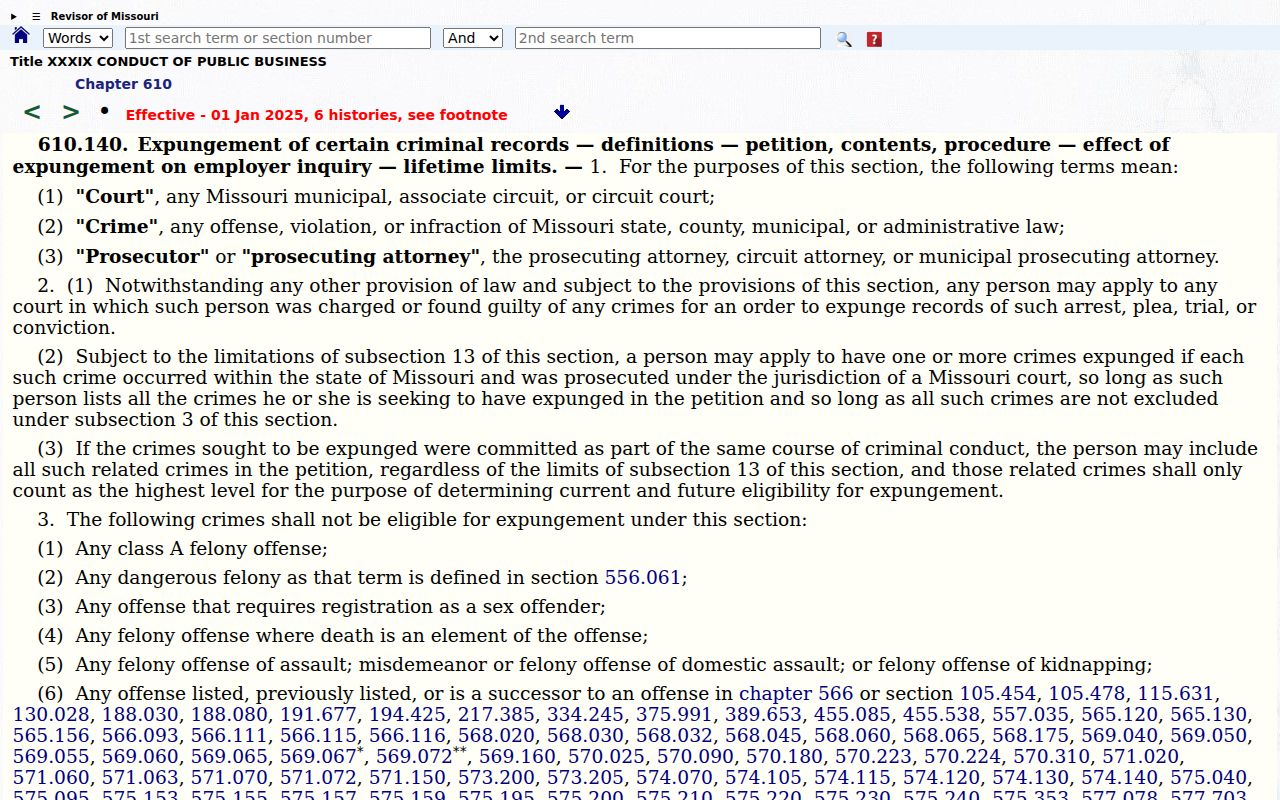
A person seeking a Wright County order files through the proper court and should use the current Missouri judiciary expungement form. After an order, certified copies help with follow-up if a source record remains wrong. The Circuit Clerk can explain filing mechanics but does not replace legal advice on eligibility.